






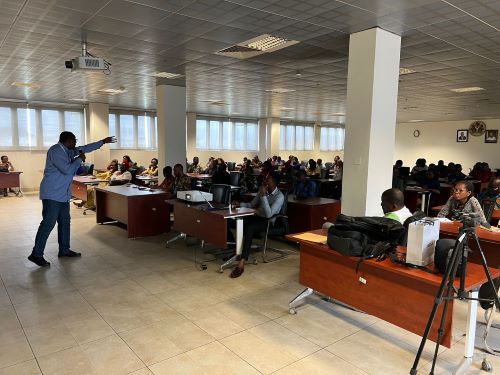


NIRSAL’s Ibrahim Suleiman taking the first Lecture in Owerri, Imo State location
NIRSAL Plc has completed a midyear training programme for lead farmers and extension agents in the Aquaculture and Cassava value chains across locations in Imo, Sokoto, Kwara, and Oyo States. The programme, aimed at boosting farmers’ capacities to access and repay commercial loans, had over 2,000 participants, with state government representatives also in attendance.
As it continues to promote the Agro Geo-Cooperative approach to primary production, NIRSAL primarily targets lead farmers with the experience and skill to share new knowledge with members of their various co-operatives for its training programmes.
In Imo State, where no less than 500 participants assembled in two locations—one urban and one rural, the focus was on efficient models for fish production. It was the same in Sokoto State, while the Oyo and Kwara outings focused on cassava.
Mr. Uche Agabige, Imo State House Committee Chairman on Agriculture, lauded NIRSAL for including Imo in this round of the capacity building programme, with the belief that it would complement local efforts aimed at boosting agricultural productivity in the state.
Head of Value Chain Capacity Development at NIRSAL Plc, Mr. Ibrahim Suleiman, said that the capacity development programme, which is part of the Technical Assistance offered by NIRSAL to agricultural value chain actors under its Technical Assistance pillar, was happening simultaneously in three other states spanning four Geo-political zones.
According to Mr. Suleiman, lead farmers and extension agents in aquaculture and cassava were similarly gathered at two urban and rural locations in Sokoto, Oyo, and Kwara States, and they are expected to cascade the training to an estimated 6,000 farmers across the states.
The NIRSAL teams received warm reception and commendations in locations, including from the Commissioner for Agriculture and Rural Development and the Akinyele Local Government Chairman in Oyo State, and the Special Adviser to the Kwara State Governor on Farmers’ Interventions, among others.
In addition to the formation of functional cooperatives with proper governance structures, the training programme also discussed readiness for possible protocol breaches and early warning systems. Participants who spoke after the lectures said that they were delighted at the new insights they gained, pledging to share same with members of their various cooperatives.
NIRSAL Plc is an initiative of the Central Bank of Nigeria (CBN) established to de-risk agriculture and agribusiness financing in Nigeria, with a view to stimulating the flow of finance and investment into the Agricultural Value Chain from multiple sources. Logic for the Imo training exercise is provided by one of the five pillars of NIRSAL—Technical Assistance, under which value chain fixing initiatives are researched, developed, and promoted.

















