






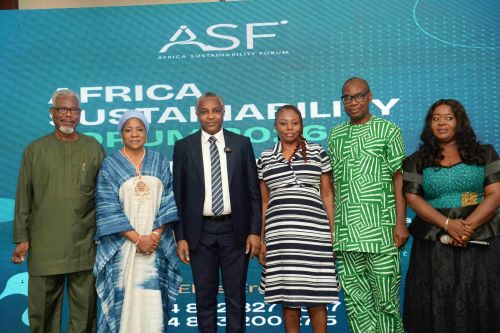


L – R: Epa Ogie Eboigbe, Publisher, Epa.com, and Executive VP of iNSDEC LTD/GTE, Olori Data Matemilola, Executive Director, Solace Foundation, and the Project Director of the Olowu Hope Initiative,
Mr. Fola Odufuwa, Managing Director, New Frontier Capital Advisors, Martha Okpeke, Director, Mediacraft Associates, Elvis Eromosele, Lead Coordinator, Africa Sustainability Forum, and Louisa Olaniyi, Compere, at the Africa Sustainability Forum which held in Lagos.
Africa’s transition to a greener economy will depend on its ability to expand affordable energy access, mobilise climate finance, create decent jobs and develop local industries, speakers at the inaugural Africa Sustainability Forum 2026 have said.
The Forum, held in Lagos, brought together business leaders, policymakers and sustainability professionals to examine how African economies can pursue climate goals while addressing poverty, infrastructure gaps and the need for industrial growth.
Under the theme Sustainable Futures: Driving Just Transitions, Green Growth and Shared Prosperity, discussions focused on the need to translate sustainability commitments into practical economic outcomes for businesses, households and communities.
In a presentation titled What Does a Just Transition Mean to Africa?, Marilyn Obaisa-Osula, Partner and Head of ESG, Sustainability and Climate Change Services and Net Zero Leader for PwC’s West Market Area, argued that Africa’s transition must reflect the continent’s development priorities.
Her presentation identified five central requirements: universal access to affordable and reliable energy, decent jobs for a growing workforce, industrialisation and local value addition, fair distribution of transition costs, and protection for workers and communities dependent on fossil-fuel industries.
The scale of the challenge is considerable. The presentation cited estimates of approximately 600 million Africans without electricity and one billion without access to clean cooking. It also highlighted a substantial financing gap, with less than $2.5 billion committed towards energy access against an estimated annual requirement of about $15 billion.
The sustainability expert argued that a credible transition must therefore expand energy access and support industrial development while keeping emissions low. She called for greater access to concessional and grant financing, the processing of critical minerals within Africa, regional value chains and stronger social protection for affected workers and communities.
Dr Aminu Maida, Executive Vice Chairman, Nigerian Communications Commission (NCC), in his presentation highlighted the importance of clear and consistent policies in giving businesses and investors the confidence to commit capital.
He discussed green telecommunications infrastructure, infrastructure sharing and the Commission’s efforts to support growth across the digital economy, stressing that a sustainable future would require effective regulation, partnerships and collaboration among stakeholders. The EVC was represented by Mrs. Oluntunde Osunleye, Principal Manager, Regulatory Services, at the Commission.
Fola Odufuwa, Managing Director of New Frontier Capital Advisors, in his fireside session titled “Beyond ESG: Financing Africa’s Next Growth Opportunity”, drew attention to the gap between Nigeria’s international connectivity and the cost of distributing internet capacity within the country. He argued that policymakers should assess infrastructure investments by the number of people and businesses that can use them, rather than by the infrastructure delivered alone.
Odufuwa also called for updated wholesale data policies and more effective implementation of regional digital and trade frameworks. He explained that the economic implications extend beyond telecommunications. Better connectivity could allow Nigerian service providers, manufacturers and entrepreneurs to reach customers across Africa, particularly as the African Continental Free Trade Area (AfCFTA) creates opportunities for trade across a market of approximately 1.4 billion people.
He posited that the Pan-African Payment and Settlement System (PAPSS), established with Afreximbank’s support, is an initiative designed to facilitate cross-border payments in African currencies and reduce reliance on traditional payment arrangements involving currencies outside the continent.
He called on African countries to draw on their own histories, institutions and development needs when shaping sustainability policies, while working with international frameworks where appropriate.
Olori Data Matemilola, Executive Director, Solace Foundation, and the Project Director of the Olowu Hope Initiative, called for sustainability initiatives to reach homes, schools and communities rather than remain confined to boardrooms and policy discussions.
She highlighted the health and environmental challenges associated with dependence on firewood and argued that cleaner cooking solutions must be affordable, accessible and safe.
She urged sustainability organisations, businesses, educators and development partners to support community-based education and help turn awareness into practical change.
Earlier In his welcome address, Elvis Eromosele, Managing Editor of TheNumbersNG.com and Lead Coordinator of ASF 2026, said the Forum was designed to focus on practical ideas, partnerships and action rather than sustainability as a concept.
The consensus at the forum: the success of the green transition will depend not only on investment and regulation but also on whether households and vulnerable communities can participate in, and benefit from, the changes taking place.
















