






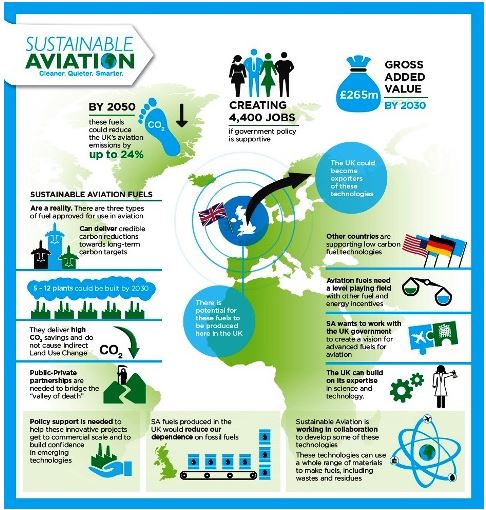


The International Air transport Association (IATA) set out an aim for one billion passengers to fly on flights powered by a mix of jet fuel and sustainable aviation fuel (SAF) by 2025. This aspiration was identified on the tenth anniversary of the first flight to blend sustainable aviation fuel and ordinary jet fuel.
On 24 February 2008, a Virgin Atlantic Boeing 747 flew from London to Amsterdam with sustainable aviation fuel in one of its engines.
The flight demonstrated the viability of drop-in biofuels, which can be blended with traditional jet fuel, using existing airport infrastructure. A flight completely powered by sustainable fuel has the potential to reduce the carbon emissions of that flight by up to 80%.
“The momentum for sustainable aviation fuels is now unstoppable. From one flight in 2008, we passed the threshold of 100,000 flights in 2017, and we expect to hit one million flights during 2020. But that is still just a drop in the ocean compared to what we want to achieve. We want 1 billion passengers to have flown on a SAF-blend flight by 2025. That won’t be easy to achieve. We need governments to set a framework to incentivize production of SAF and ensure it is as attractive to produce as automotive biofuels,” said Alexandre de Juniac, IATA’s Director General and CEO.
The push to increase uptake of SAF is being driven by the airline industry’s commitment to achieve carbon-neutral growth from 2020 and to cut net carbon emissions by 50% compared to 2005. A number of airlines, including Cathay Pacific, FedEx Express, JetBlue, Lufthansa, Qantas, and United, have made significant investments by forward-purchasing 1.5 billion gallons of SAF.
Airports in Oslo, Stockholm, Brisbane and Los Angeles are already mixing SAF with the general fuel supply. On the present uptake trajectory it is anticipated that half a billion passengers will have flown on a SAF-blend powered flight by 2025.
But if governments, through effective policy, help the sustainable fuel industry to scale-up its production, it is possible that one billion passengers could experience an SAF flight by 2025. The steps needed to deliver this include:
Allowing SAF to compete with automotive biofuels through equivalent or magnified incentives
Loan guarantees and capital grants for production facilities
Supporting SAF demonstration plants and supply chain research and development
Harmonized transport and energy policies, coordinated with the involvement of agriculture and military departments.
Acknowledging that some sources of biofuels for land transport have been criticized for their environmental credentials, de Juniac emphasised strongly the determination of the industry to only use truly sustainable sources for its alternative fuels.
“The airline industry is clear, united and adamant that we will never use a sustainable fuel that upsets the ecological balance of the planet or depletes its natural resources,” he said.
















